


Reid panda
 | The "Scots" that wis uised in this airticle wis written bi a body that haesna a guid grip on the leid. Please mak this airticle mair better gin ye can. (Februar 2021) |
| Red panda | |
|---|---|

| |
| A reid panda at the Cincinnati Zoo | |
Scientific classification 
| |
| Kinrick: | Animalia |
| Phylum: | Chordata |
| Cless: | Mammalia |
| Order: | Carnivora |
| Faimily: | Ailuridae |
| Genus: | Ailurus F. Cuvier, 1825 |
| Species: | A. fulgens |
| Binomial name | |
| Ailurus fulgens F. Cuvier, 1825
| |
| Subspecies | |
|
A. f. fulgens F. Cuvier, 1825 | |

| |
| Range o the reid panda | |
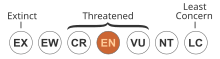
The reid panda (Ailurus fulgens), cried the lesser panda an reid cat-bear forby, is a smaw mammal hamelt in the eastren Himalayas an sooth-wast Cheenae that haes been classified as an Endangered bi IUCN as its wild population is estimatit at less nor 10,000 mature individuals. The population continues tae decline an is threatened bi habitat loss an fragmentation, poachin, an inbreedin depression, altho reid pandas are protectit bi naitional laws in thair range kintras.[1]
The reid panda is slichtly lairger than a domestic cat. It has reiddish-broun fur, a lang, shaggy tail, an a waddlin gait due tae its shorter front legs. It is arboreal an feeds mainly on bamboo, but is omnivorous an is kent tae eats eggs, [[bird|birds], inssects, an smaw mammals. It is a solitary ainimal, mainly active frae dusk tae dawn, an is lairgely sedentary durin the day.
The reid panda is the anely livin species o the genus Ailurus an the faimily Ailuridae. It haes been previously placed in the raccoon an beir faimilies, but results o phylogenetic research indicate strang support for its taxonomic classification in its awn faimily Ailuridae, which alang wi the weasel faimily is pairt o the superfaimily Musteloidea.[4] Traditionally it wis thoucht to hae twa subspecies.[3] Houiver , genetic analysis indicates that thare are likly twa reid panda species, the Chinese reid panda and the Himalayan reid panda, that genetically diverged 0.22 million years aby.[5]
References
[eedit | eedit soorce]- ↑ a b Glatston, A.; Wei, F.; Than Zaw & Sherpa, A. (2015). "Ailurus fulgens". The IUCN Red List of Threatened Species. IUCN. 2015: e.T714A110023718. doi:10.2305/IUCN.UK.2015-4.RLTS.T714A45195924.en. Retrieved 29 October 2018. Cite uses deprecated parameter
|last-author-amp=(help){{cite iucn}}: error: |doi= / |url= mismatch (help) - ↑ Thomas, O. (1902). "On the Panda of Sze-chuen". Annals and Magazine of Natural History. Seventh Series. X. London: Gunther, A.C.L.G., Carruthers, W., Francis, W. pp. 251–252. doi:10.1080/00222930208678667.
- ↑ a b Wozencraft, W. C. (2005). "Order Carnivora". In Wilson, D. E.; Reeder, D. M (eds.). Mammal Species of the World (3rd ed.). Johns Hopkins University Press. pp. 532–628. ISBN 978-0-8018-8221-0. OCLC 62265494. Cite error: Invalid
<ref>tag; name "msw3" defined multiple times wi different content - ↑ Flynn, J. J.; Nedbal, M. A.; Dragoo, J. W.; Honeycutt, R. L. (2000). "Whence the Red Panda?" (PDF). Molecular Phylogenetics and Evolution. 17 (2): 190–199. doi:10.1006/mpev.2000.0819. PMID 11083933. Retrieved 23 September 2009.
- ↑ Cite error: Invalid
<ref>tag; no text was provided for refs namedHu
Freemit airtins
[eedit | eedit soorce]- Reid Panda Network, USA – The warld's anly non-profit organization dedicated tae reid panda conservation.
- Reid Panda Network, Nepal Archived 2009-09-23 at the Wayback Machine
- ARKive: Reid panda Archived 2008-10-15 at the Wayback Machine Archived 2008-10-15 at the Wayback Machine
- Ainimal Diversity Wab Ailurus fulgens. Retrieved on 2009-11-26.
- Ainimal Info: Reid Panda
- Birmingham Nature Centre Archived 2015-06-16 at the Wayback Machine – UK breedin program. Retrieved on 2009-11-26.

 | This ainimal-relatit airticle is a stub. Ye can help Wikipaedia bi expandin it. |
- Cite iucn errors
- IUCN Reid Leet endangered species
- Fauna o the Himalayas
- Mammals o Indie
- Fauna o Sooth Asie
- Fauna o East Asie
- Mammals o Nepal
- Mammals o Bhutan
- Mammals o Cheenae
- Mammals o Laos
- Mammals o Burma
- Livin fossils
- EDGE species
- Wildlife o Yunnan
- Monotypic mammal genera
- Ainimals descrived in 1825
- Ainimal stubs